
Le corps m’a dit
Ma rencontre avec le Wholebody Focusing

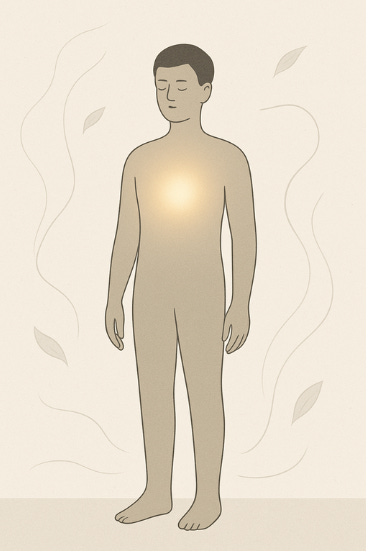
Quand le corps prend la parole
Il y a des jours où mon corps crie, sans un mot.
Il se raidit, se fatigue, se referme.
Il m’envoie des signaux clairs, mais je suis ailleurs, absorbé(e) par des obligations, des objectifs, des attentes.
Alors il insiste : un nœud dans la gorge, un poids dans la poitrine, une boule au ventre.
Il ne cherche pas à me punir.
Il veut simplement que je l’écoute.
J’ai appris, parfois à mes dépens, que le corps finit toujours par se faire entendre.
Quand on ne l’écoute pas en douceur, il hausse le ton : une douleur persistante, une maladie, un effondrement.
Comme un enfant qu’on ignore trop longtemps, il finit par crier pour qu’on lui accorde enfin de l’attention.
Le Wholebody Focusing, c’est le moment où le corps prend la parole.
Il nous parle à sa manière.
On dépasse le stade de l’attention silencieuse pour entrer dans un véritable dialogue. Le corps devient un partenaire actif.
Dans cette pratique, il s’exprime par des mouvements spontanés, des ressentis qui évoluent, des images inattendues, des pensées qui n’émergent jamais par hasard.
Il dit ce que les mots ne peuvent formuler.
Il dit ce que la pensée ne peut prévoir.
Il dit ce qui cherche à émerger.
Le Wholebody Focusing nous apprend simplement à entrer en résonance avec lui, pour rendre explicite ce qu’il veut nous montrer.
Être autonome
Lorsque j’ai rencontré Kevin McEvenue, je venais de terminer ma formation d’enseignant en technique Alexander.
Je pratiquais déjà comme ostéopathe depuis une dizaine d’années, en prise directe avec les questionnements des patients — et notamment cette question récurrente :
« Et moi, qu’est-ce que je peux faire, de mon côté, pour aller mieux ? »
La technique Alexander m’avait apporté une réponse précieuse : en apprenant à interrompre les automatismes, on retrouve un alignement plus naturel.
Mais à mes yeux, il manquait une dimension essentielle : l’autonomie.
L’élève restait dépendant de l’intervention du professeur.
Je pressentais qu’il existait une autre voie, où la personne pourrait mobiliser ses propres ressources.
C’est alors que j’ai lu un article de Kevin McEvenue.
Ce professeur de technique Alexander, également formé au Focusing de Gene Gendlin, présentait une synthèse personnelle entre les deux approches, qu’il avait appelée Wholebody Focusing.
Il ne s’agissait plus de corriger ni d’instruire, mais de créer les conditions d’un dialogue intérieur, dans lequel le corps tout entier devenait le guide.
Ce fut une révélation.
Une expérience qui parle d’elle-même
Grâce à deux praticiennes québécoises — Marine de Fréminville et Thérèse Fortier — j’ai pu m’initier au Focusing, puis rencontrer Kevin à Toronto.
Ce jour-là, alors que mon anglais restait approximatif, quelque chose d’essentiel s’est pourtant dit entre nous — sans passer par les mots.
Kevin était ce qu’il transmettait.
Sa parole semblait vibrer dans tout son corps, et cette vibration se propageait jusqu’au mien.
Il n’y avait rien à comprendre.
Juste à ressentir.
Lors de notre premier échange, il m’a simplement invité à sentir la globalité de mon corps, soutenu par mes appuis dans le sol.
Et tout a changé.
Des mouvements sont venus spontanément, des sensations ont émergé de l’intérieur, hors de mon contrôle.
Le corps s’animait de lui-même, comme s’il révélait quelque chose.
Il me parlait.
Cette première expérience m’a profondément marqué.
Je suis retourné apprendre auprès de Kevin, et j’ai découvert peu à peu les effets étonnants de cette pratique :
une seule séance a suffi à faire disparaître une inflammation oculaire résistante aux traitements classiques ; une autre a soulagé un lumbago aigu en quelques minutes.
Dans chaque cas, le Wholebody Focusing me montrait l’origine du symptôme.
Le corps me guidait, m’indiquait où porter mon attention.
Je découvrais en lui une intelligence vivante, sensible, qui savait ce dont j’avais besoin avant même que je le comprenne.
Le corps, guide intérieur
Le Wholebody Focusing repose sur une confiance radicale : le corps sait.
Non pas au sens médical ou mécanique, mais comme une connaissance intuitive, presque « organique ».
Le corps nous parle par des ressentis subtils, des mouvements involontaires, des images, parfois des tremblements ou des pensées en lien direct avec le moment présent.
Il a sa propre logique.
Et il peut nous révéler des compréhensions profondes que l’intellect seul ne peut atteindre.
Avec le temps, cette écoute devient un art de vivre.
Il ne s’agit plus de résoudre un problème, mais d’être présent à ce que nous ressentons.
De cette qualité d’attention peuvent surgir des transformations réelles — physiques, émotionnelles, existentielles.
Une pratique sans effort, mais exigeante
Comme dans la technique Alexander, il n’y a rien à faire, au sens habituel.
Il s’agit de permettre, de ne pas interférer.
La technique Alexander apprend à suspendre les automatismes ;
le Wholebody Focusing ouvre un espace où le corps peut s’exprimer librement, au-delà du mental et de la volonté.
Cela demande du courage :
le courage de ne pas contrôler, de ne pas savoir, d’oser ressentir sans orienter.
Mais ce que l’on reçoit en retour est inestimable :
un sentiment d’alignement profond, une cohérence entre ce que l’on pense et ce que l’on ressent.
Une sensation d’unité.
When the Body Finds Its Voice
Before we even think about movement, there is a space to listen to.
There are days when my body cries out—without a single word.
It tightens, grows tired, withdraws.
It sends clear signals, yet I am elsewhere, absorbed by obligations, goals, expectations.
So it insists.
A knot in the throat.
A weight in the chest.
A tightening in the belly.
It is not trying to punish me.
It simply wants to be heard.
I have learned—sometimes the hard way—that the body will always make itself known.
When it is not listened to gently, it raises its voice: a persistent pain, an illness, a collapse.
Like a child ignored for too long, it eventually screams to receive the attention it has been asking for all along.
Le corps m’a dit is a reader-supported publication.
To receive new posts and support my work, consider becoming a free or paid subscriber.
When the Body Speaks
Wholebody Focusing is the moment when the body begins to speak.
It speaks in its own language.
We move beyond silent attention and enter a true dialogue.
The body becomes an active partner.
In this practice, it expresses itself through spontaneous movements, shifting sensations, unexpected images, thoughts that never arise by chance.
It says what words cannot formulate.
It says what thought cannot predict.
It says what is seeking to emerge.
Wholebody Focusing simply teaches us how to resonate with this language—to allow what is implicit to become visible.
Learning Autonomy
When I first met Kevin McEvenue, I had just completed my training as an Alexander Technique teacher.
I had already been practicing as an osteopath for nearly ten years, closely connected to patients’ questions—especially this recurring one:
“And what can I do myself to get better?”
The Alexander Technique had given me a precious answer: by interrupting habitual patterns, a more natural alignment can emerge.
Yet, to my eyes, something essential was missing—autonomy.
The student remained dependent on the teacher’s intervention.
I sensed that another path existed, one in which a person could access their own internal resources.
That was when I read an article by Kevin McEvenue.
An Alexander Technique teacher trained in Gene Gendlin’s Focusing, he presented a personal synthesis of the two approaches, which he called Wholebody Focusing.
There was no correction, no instruction—only the creation of conditions for an inner dialogue, where the entire body became the guide.
It was a revelation.
An Experience That Speaks for Itself
Thanks to two practitioners from Quebec—Marine de Fréminville and Thérèse Fortier—I was introduced to Focusing and later met Kevin in Toronto.
That day, although my English was still uncertain, something essential passed between us—without words.
Kevin was what he taught.
His speech seemed to vibrate through his entire body, and that vibration reached mine.
There was nothing to understand.
Only to feel.
During our first exchange, he simply invited me to sense my body as a whole, supported by its contact with the ground.
And everything changed.
Movements arose spontaneously.
Sensations emerged from within, beyond my control.
The body animated itself, as if revealing something.
It was speaking to me.
This first experience marked me deeply.
I returned to study with Kevin and gradually discovered the remarkable effects of this practice:
a single session resolved an eye inflammation resistant to conventional treatment; another eased an acute lower-back pain within minutes.
Each time, Wholebody Focusing revealed the origin of the symptom.
The body guided me, showing where attention was needed.
I encountered within myself a living, sensitive intelligence—one that knew what I needed even before I could understand it.
The Body as an Inner Guide
Wholebody Focusing rests on a radical trust: the body knows.
Not in a medical or mechanical sense, but as an intuitive, organic knowing.
The body speaks through subtle sensations, involuntary movements, images, tremors, or thoughts arising directly from the present moment.
It follows its own logic.
And it can reveal understandings that the intellect alone cannot reach.
Over time, this listening becomes a way of life.
It is no longer about solving a problem, but about being present with what is felt.
From this quality of attention, real transformations can emerge—physical, emotional, existential.
A Practice Without Effort—Yet Demanding
As in the Alexander Technique, there is nothing to do in the usual sense.
It is about allowing, about not interfering.
The Alexander Technique teaches the suspension of habits.
Wholebody Focusing opens a space where the body can express itself freely, beyond mental control or willpower.
This requires courage:
the courage not to control, not to know, to dare to feel without directing.
What comes in return is invaluable:
a deep sense of alignment, coherence between thought and feeling.
A lived experience of unity.
Listening to the body is not a new invention. It has a lineage. To follow it further, we can turn to Gene Gendlin, who showed how meaning begins to move when the body is truly heard.
Exploring the body from within, where movement precedes effort.